This is Mr. Reid Dennis, who ordered his new S550 way back in October of 2009! He took delivery today at his home in Woodside, and I think his new car is just gorgeous, don't you? Palladium Silver with the Savannah Beige interior. Aaaah!
Reid has the most amazing collection of model trains and antique prints of San Francisco. Don't we have the best customers?
Friday, March 26, 2010
Tuesday, March 16, 2010
Mercedes Drivers Safer Than Drivers of other Cars (from German Car Scene)
Stuttgart – The evidence is now clear: drivers of Mercedes vehicles are safer on the road than drivers of other car brands. This is the result of a study of Mercedes accident research based on official, anonymous data samples from the Federal Office of Statistics.

Having looked at 18,748 accidents resulting in personal injury during the period from 2003 to 2007, the study found that the risk of being seriously or fatally injured as the driver of a E?Class, is 10.4 percent lower than for comparable vehicles of other brands.
The study did not even allow for the fact that Mercedes-Benz vehicles are involved in accidents less frequently than the vehicles of other brands – primarily because, among other reasons, Mercedes-Benz was the first manufacturer to introduce ESP® across the board. The study of accident severity only took into account accidents resulting in personal injury. The criteria were initial registration from 2002 onwards, as well as a performance and weight class corresponding to the E?Class.
The result represents clear evidence of the contribution made by the passive safety systems of Mercedes-Benz to reducing the consequences of an accident. Thanks to adaptive front airbags and belt-force limiters, which can adapt to the severity of an impact, rollover sensors, windowbags as standard and an intelligently designed body structure which provides occupants with excellent protection even in the event of severe collisions, at the time of its world premiere in 2002 the E-Class became the new benchmark for passenger car safety in the luxury class.
In the course of a facelift of the E-Class in the spring of 2006, the Mercedes engineers continued to achieve further substantial advances in the field of high-level safety, equipping the E-Class with safety systems which no other passenger car in this class was able to offer. At the time PRE-SAFE® was introduced, the interlinking of systems for accident prevention with occupant protection marked the start of a new era in this vehicle class. This Mercedes invention takes advantage of the time between detecting an accident-prone situation and possible accident damage for occupant protection. With the new E-Class, Mercedes-Benz has continued to build on the advances being made in the field of safety. Around a dozen new or enhanced driver assistance systems contribute to preventing accidents and reducing the severity of an impact. These include the ATTENTION ASSIST drowsiness detection system, as well as the optional DISTRONIC PLUS proximity control system and PRE-SAFE® Brakes with autonomous emergency braking. For the first time, PRE-SAFE® can also make use of information from the short-range radar sensors in the front bumper to tighten the front seat belts in the very last split second before an unavoidable accident, thus helping to reduce the loads suffered by the driver and front passenger in a crash.
With nine airbags as standard, four seat-belt tensioners and belt-force limiters as well as crash-responsive NECK-PRO head restraints for driver and front passenger, the new E-Class provides an even more comprehensive level of safety equipment than its predecessor. As well as the air cushions, which can be activated in milliseconds in the event of an accident, there are also two adaptive airbags for the driver and front passenger, a kneebag for the driver, two sidebags in the front seat backrests, and also two generously sized windowbags which span the area from the A to the C-pillar in the event of a side impact. For the first time, pelvisbags have also been incorporated for the front seat occupants. These can also help to reduce loads in the upper body and pelvic areas in the event of a side collision. Sidebags are also available as an optional extra for the rear passengers, while another safety innovation includes automatic adaptive belt-force limiters in the rear, now available for the first time as an option from Mercedes-Benz. These adjust automatically to the size and weight of the passengers.
[Source: Mercedes-Benz]
This is from "the world's #1 English-speaking German car blog". In Germany, where they take their safety way seriously, Mercedes engineers are allowed by the Police to inspect the scene of a highway crash involving a Benz to learn how to make the cars safer in the future. Mercedes is the only manufacturer allowed this privilege. Engineers are on call 24-hours a day at the factory to respond to a report of a crash within a 100-mile radius of the plant. Dedication to your family's safety doesn't take the night off.

Having looked at 18,748 accidents resulting in personal injury during the period from 2003 to 2007, the study found that the risk of being seriously or fatally injured as the driver of a E?Class, is 10.4 percent lower than for comparable vehicles of other brands.
The study did not even allow for the fact that Mercedes-Benz vehicles are involved in accidents less frequently than the vehicles of other brands – primarily because, among other reasons, Mercedes-Benz was the first manufacturer to introduce ESP® across the board. The study of accident severity only took into account accidents resulting in personal injury. The criteria were initial registration from 2002 onwards, as well as a performance and weight class corresponding to the E?Class.
The result represents clear evidence of the contribution made by the passive safety systems of Mercedes-Benz to reducing the consequences of an accident. Thanks to adaptive front airbags and belt-force limiters, which can adapt to the severity of an impact, rollover sensors, windowbags as standard and an intelligently designed body structure which provides occupants with excellent protection even in the event of severe collisions, at the time of its world premiere in 2002 the E-Class became the new benchmark for passenger car safety in the luxury class.
In the course of a facelift of the E-Class in the spring of 2006, the Mercedes engineers continued to achieve further substantial advances in the field of high-level safety, equipping the E-Class with safety systems which no other passenger car in this class was able to offer. At the time PRE-SAFE® was introduced, the interlinking of systems for accident prevention with occupant protection marked the start of a new era in this vehicle class. This Mercedes invention takes advantage of the time between detecting an accident-prone situation and possible accident damage for occupant protection. With the new E-Class, Mercedes-Benz has continued to build on the advances being made in the field of safety. Around a dozen new or enhanced driver assistance systems contribute to preventing accidents and reducing the severity of an impact. These include the ATTENTION ASSIST drowsiness detection system, as well as the optional DISTRONIC PLUS proximity control system and PRE-SAFE® Brakes with autonomous emergency braking. For the first time, PRE-SAFE® can also make use of information from the short-range radar sensors in the front bumper to tighten the front seat belts in the very last split second before an unavoidable accident, thus helping to reduce the loads suffered by the driver and front passenger in a crash.
With nine airbags as standard, four seat-belt tensioners and belt-force limiters as well as crash-responsive NECK-PRO head restraints for driver and front passenger, the new E-Class provides an even more comprehensive level of safety equipment than its predecessor. As well as the air cushions, which can be activated in milliseconds in the event of an accident, there are also two adaptive airbags for the driver and front passenger, a kneebag for the driver, two sidebags in the front seat backrests, and also two generously sized windowbags which span the area from the A to the C-pillar in the event of a side impact. For the first time, pelvisbags have also been incorporated for the front seat occupants. These can also help to reduce loads in the upper body and pelvic areas in the event of a side collision. Sidebags are also available as an optional extra for the rear passengers, while another safety innovation includes automatic adaptive belt-force limiters in the rear, now available for the first time as an option from Mercedes-Benz. These adjust automatically to the size and weight of the passengers.
[Source: Mercedes-Benz]
This is from "the world's #1 English-speaking German car blog". In Germany, where they take their safety way seriously, Mercedes engineers are allowed by the Police to inspect the scene of a highway crash involving a Benz to learn how to make the cars safer in the future. Mercedes is the only manufacturer allowed this privilege. Engineers are on call 24-hours a day at the factory to respond to a report of a crash within a 100-mile radius of the plant. Dedication to your family's safety doesn't take the night off.
Newest, happy customer
This is the marvelously talented Scott Compton, who took delivery this weekend of his 2010 E350 in triple black. He says the new car is even better than the 07 E350 he returned off lease, and he really is enjoying the improved technological features in the car. And Scott really knows technology, as he is the helmsman behind Remedy Editorial here in The City. His company does corporate videos for HUGE clients, incorporating motion capture and HD. You should check out his work, it is beautiful.
Thank you for leasing your car from us, Scott. Enjoy!
Saturday, March 13, 2010
from Benz Insider, awards for the E-Class body
The Mercedes E-Class wins award for “Best Bodyshell 2009″
Mon, Nov 16, 2009
E-class

The Mercedes E-Class wins the coveted “EuroCarBody Award 2009″. At EuroCarBody, the world’s largest car body benchmarking conference, a jury made up of about 400 conference delegates and board members voted the E-Class as the car with the best bodyshell. A total of nine new series-production bodies were presented in detail and scrutinised at the EuroCarBody event held in Bad Nauheim, Germany at the end of October. The candidates included the Jaguar XJ, Audi R8 spyder and BMW 5 Series GT.
“We are delighted to receive this award. EuroCarBody is after all the foremost conference for car body experts worldwide, meaning that it attracts top-ranking delegates,” explains Dr. Jörg Langner, who heads the Detachable Front End Body Parts team at Mercedes-Benz Cars Development. “Plus, it means we have come full circle: seven years ago, the previous E-Class model was crowned the winner of the first ever EuroCarBody Award, which has been presented annually ever since.”
The model series owes its triumph primarily to the top results it secured in the two voting categories “Customer value” and “Innovative process, production and plant concepts”. As for all other product characteristics, the bodyshell forms a foundation here on which the experts from the other specialist disciplines build. Dr. Langner analyses the result as follows: “It wasn’t a particular innovation which clinched it, but the harmonious overall concept.” In the “Customer value” category, for instance, the jury rewarded the exemplary safety concept and comfort level in the E-Class and its outstanding aerodynamics. For all these qualities the bodyshell is the most important element.
The active bonnet is just one of many features which illustrate how development of the E-Class body focused on customer value at all times. It reduces the risk of injury to pedestrians as well as offering E-Class owners a further crucial benefit: the active bonnet has a reversible design. So, if it is triggered by a minor parking bump, for example, Mercedes customers can simply return the bonnet to its original position – reactivating the system in the process – then continue with their journey.
“Our customer-focused approach is plain to see in the production concept for the Mercedes E-Class too,” points out Stefan Tritschler, Project Manager for Body Manufacture. “Guaranteeing supreme quality from the outset results in the ultimate in customer value.” This is made possible by sophisticated manufacturing and quality assurance methods. Besides the customary quality assurance measures, process monitoring procedures are employed for all joining operations to safeguard quality during each and every manufacturing step. The state-of-the-art RobScan robot-guided laser welding process, for example, is likewise subject to 100% monitoring. This new welding technology not only achieves a very high welding speed, it produces welding seams of the highest quality. During manufacture of the Mercedes-Benz E-Class body, RobScan welding is employed first and foremost for the doors, sidewalls and rear-end centre assembly.
And don't you love that they call it a "bonnet"? So much nicer than "hood". Will the innovations and quality never stop? It's hardly fair. How will the others keep up?
New safety patents in the making....
Mercedes Builds A Car To Protect Us From Ourselves
- By Caitlin Hamilton
- March 12, 2010 |
- 8:00 am |

MONTVALE, New Jersey — Mercedes-Benz has been on a relentless quest to achieve hyper-safe accident-free driving since 1959, when it introduced the first car to feature energy-absorbing crumple zones. At long last, it’s getting pretty close to reaching its goal.
The Experimental Safety Vehicle concept car essentially turns the entire vehicle into an airbag using novel metal panels that inflate moments before impact. The company’s first all-out attempt at building a perfectly safe car since the original ESF in 1974 is packed with technology designed to save us from ourselves. Mercedes recently opened the doors to its North American headquarters to tell us more about the car.
Mercedes isn’t alone on its quest. Volvo, to name one example, wants to offer an almost injury-proof car by 2020, and Sweden’s head of traffic safety says it will be the biggest revolution in the auto industry since the seatbelt. Automakers are pouring colossal amounts of money into the campaign to increase safety, something Mercedes says is imperative.
“This is a comprehensive embodiment of our safety philosophy,” Dr. Ing. Rodolfo Schöneburg, head of safety development at Mercedes, said in a statement. “The primary aim is to prevent accidents in the first place. Where this is not possible, the aim is to mitigate their effects”
The goal, he said, is not to remove the driver from the equation or absolve them of responsibility, but to aid them in maximizing safety.
“The car should provide support in the process,” he said.
To that end, the “pre-safe” system in the ESF 2009 features a pair of video cameras, a long-range infrared sensor on the front fender and six short-range sensors around the car, all of them working to see accidents before they happen and react to them before we’re even aware of the danger. Mercedes calls it “pre-safety.” Think Minority Report but without Tom Cruise and that old murderer guy.
The pre-safety routine starts before you’ve even put the car in gear as the airbags automatically adjust to suit each occupant. But things really get interesting when the car senses a collision is imminent. The “Pre-Safe 360″ system monitors the area around the car to a distance of 200 feet, creating an early-warning system. Should it sense an imminent collision, all kinds of cool things happen.
Within milliseconds the car moves the seats inward by as many as 50 millimeters, which Mercedes says reduces by one-third the forces acting on the occupant during a lateral impact. The system also triggers the airbags automatically, rather than waiting for the impact, and — coolest of all — inflates key chassis components to absorb the impending impact. Airbags may sound like old-school tech, but Mercedes is redefining them.
Automated sensors control the expansion and tension of the airbag to account for the passenger’s size and weight. In other words, a fat guy will be protected by a bag that is larger and firmer than the bag deployed for a petite woman. The ESF also features airbags between the seats that inflate in a crash to protect passengers like eggs in a carton. Passengers in the back seat are protected by airbags mounted in the seatbelts, something Ford plans to offer in the 2011 Explorer.
But the really cool bit is the “braking bag” under the car. It is encased in steel and rubber and mounted at the front of the car. When deployed, it briefly increases the rate of deceleration to 20 meters per second squared and raises the car as much as 8 centimeters to minimize brake dive, which occurs when you stomp on the brake. It also lifts the front bumper to align, as closely as possible, with bumper of the car ahead. As an added bonus, Mercedes says, the force produced by the sudden lifting of the front end pushes passengers back in their seats, increasing the effectiveness of seatbelts and airbags.
Mercedes likens the braking airbag to the parachutes on a dragster and says it effectively increases the size of the crumple zone at the front of the car. Its engineers have calculated that even at 30 mph the additional deceleration provided by the bag has the same effect as lengthening the front end by 7 inches.
But wait. There’s more.
When the car senses a side impact or potential rollover, the pre-safety system inflates metallic “pockets” in the body, causing them to pop out (see the diagram) and provide additional impact absorption. If you’re about to get whacked from behind, the pre-safety system flashes the brake lights to warn the guy behind you, then applies the brakes to prevent you from hitting the guy ahead of you. It also activates a “neck-pro” system that minimizes the likelihood of whiplash by moving the headrests forward about 1.5 inches and up about 1 inch within milliseconds.
Couple all of these features with more standard fare like blind-spot assist, infrared cameras that highlight hazards ahead and you get a car that is damn near omnipotent in its ability to protect you from whatever trouble you might get into.
Mercedes concedes that all the safety gadgets would undoubtedly increase the cost of their cars, which already start at $33,600 here in the United States. But Mercedes says price isn’t the biggest consideration for a company with a reputation for safety innovations — and customers who tend to demand such innovations.
“When you add more features, the prices goes up,” said Michael Fehring, manager of strategy and concepts Mercedes-Benz’s development headquarters in Germany. “Ultimately, you get what you pay for.”
That said, any discussion of price is academic at this point, because the ESF is just a concept and the safety systems are still in development. Mercedes hopes to bring down the costs and offer them in all of its vehicles. When?
“Soon,” Fehring says.
The tech will most likely roll out in three phases, Fehring says. First we’ll see cars with the ability to pre-trigger existing safety tools like the airbags. Next we’ll see seat and headrests that adjust before impact to offer optimal protection. Then we’ll get the really advanced stuff like the middle airbags, Transformer-style inflating panels and the braking bag.
Looking further down the road, Mercedes sees a day when cars can “talk” to one another using WLAN and other technology. Among other things, cars could relay warnings about bad weather ahead or obstacles in the road. Such technology is still in its infancy, but Mercedes says it is testing it. It’s far fetched, but then so is most of the stuff in the ESF. That’s the point.
“The ESF just shows what’s possible,” Fehring said. “Hopefully it will eventually make us all safer.”
Photos and diagrams: Mercedes-Benz

The Pre-Safe system uses inflatable metal pockets in the body that work much an air mattress to absorb impact.
The braking bag deploys like an airbag to slow and raise the car before impact.
Pre-Safe Pulse moves passengers toward the center of the car in a side-impact crash, and between-seat airbag offer more protection.
Never resting in the pursuit of safety innovation, and note, ever willing to share that safety with everyone, not just those who drive Mercedes.
The ML350 Bluetec, in our parking lot at dusk
To think, you can buy this work of art and drive it every day.....but only if you can pry it away from our General Manager, who is driving it as his demo for now!
Photo © Liz Boeder 2010
Friday, March 12, 2010
How not to park, Part 3
That should buff out.....
Notice how the driver and passenger were able to casually open the doors, climb out, walk away and act as if nothing happened. "They really should plug up that hole in the parking garage, it gets drafty this time of year".
Thursday, March 11, 2010
Magpies like it
- Permanently solving the "I can't find my car in the private jet parking lot" problem that so many of us have these days.
- Also solving the "I hate it when my car can't be seen on Google Earth" problem.
- Also solving the "I need to block radio signals from aliens trying to communicate with me" problem.
- Also solving the "How can I make my car look like a refrigerator door handle from the fifties" problem.
- Also solving the "What do I do with all this aluminum foil I've been meaning to recycle" problem.
Would it have been too blingy if they had chromed the wheels? I'm just saying....
Wednesday, March 10, 2010
If it's safe enough for the Pope, it's safe enough for me.
Note that the Pope is not being driven in a modified Lexus, or BMW, or Audi, or Bentley, or Jaguar, or even that paragon of safety, a Volvo. The one on earth who speaks directly to God, according to the sacred beliefs of the those of the Catholic faith, shepherds his flock from the robust and reliable Mercedes G-Wagon. Why would the Pope choose a Mercedes? Maybe it's because it's the safest way to travel this earthly domain.
Maybe the G stands for God?
Tuesday, March 9, 2010
From MB World blog, a poster still alive thanks to his C280
I'd like to point out that when we have C280s for sale, they generally run about $7,000-10,000. That's the most effective insurance policy you can buy.
"I loved my C280, it handled great, saved my life, but was NOT a fast car, I repeat NOT.
I agree with you, I may end up being impatient and going for the C43, we will see.


I walked away! .....after I woke up
"
We're glad you're still around to contemplate your next Mercedes...whoever you are.
"I loved my C280, it handled great, saved my life, but was NOT a fast car, I repeat NOT.
I agree with you, I may end up being impatient and going for the C43, we will see.


I walked away! .....after I woke up
"We're glad you're still around to contemplate your next Mercedes...whoever you are.
Monday, March 8, 2010
Mercedes at the forefront of the future of safety
March 5, 2010, 2:00 pm
The Child Protect seat and inflatable belt for rear seat passengers in the Mercedes-Benz ESF 2009.MONTVALE, N.J. — Just before heading back home to Germany following a short tour of the United States, Mercedes-Benz’s ESF 2009 experimental safety vehicle made one last pitstop before a gaggle of American reporters in northern New Jersey. It offered a tantalizing glimpse of more than a dozen different systems designed to make driving (and crashing) safer.
Closest on the horizon is a new type of child seat, according to the ESF’s project manager, Michael Fehring. The Child Protect System is essentially a child seat with steel reinforced padded bolsters and a cut-out backrest to accommodate children from three to 12 years old. The steel supports and side pads are intended to protect tots from car parts penetrating the interior, and it makes current plastic booster seats look like Tinker Toys. Unfortunately, the seat, which will fit in any vehicle, probably won’t hit the market for three years, said Mr. Fehring.
Further into the future is the possibility of active door supports that pop out on the sides of the car 20 to 30 milliseconds before a crash to protect from side impacts. Complementary to this are “interseat protection” systems, including a firm air bag that deploys near the side the driver’s headrest in the event of a rollover. It’s intended to prevent driver and passenger from injuring each other.
There are also “virtual crumple zones” created by a bevy of technologies, including a half-dozen radar sensors. Altogether, they make up the Pre-Safe 360 system. Among its many features is the coordination of several systems to reduce the danger of accidents that occur when the car is stopped.
Mr. Fehring described a situation in which a driver is sitting at a red light when suddenly the car senses that it may be hit from behind by another vehicle. The first thing the Pre-Safe 360 system will do is rapidly flash its taillights to alert the other driver. If that fails to slow the oncoming car, within milliseconds the Mercedes system will apply full brake (so if your foot slips off the brake pedal on impact, the brakes are still fully engaged). It will also trigger the car’s neck protection system to try to prevent whiplash.
Mercedes clearly wants to return to the mid-1970s heyday of cooperative development of safety systems that produced de facto standards such as anti-lock brakes. The ESF 2009 is intended to re-ignite such cooperation. For example, Mr. Fehring pointed out that while vehicle-to-vehicle communication to prevent collisions is still many years away, Mercedes is working with several consortia to develop standards. Indeed, the company has demonstrated such collision avoidance in coordination with BMW vehicles.
The Mercedes staff fended off questions about prices and costs, pointing out that when it comes to safety, you get what you pay for. Clearly the company also hopes drivers will agree with a mantra repeated several times at the demonstration: Safety sells.
This may make some people wonder why Mercedes doesn't do more to promote their safety technologies to the market through their advertising, but we're just glad all that good stuff is in there. We can trust that Mercedes is always doing everything possible to advance the safety of the family.
Mercedes-Benz ESF 2009 Tests Future Safety Technology
By JOHN R. QUAIN
The Child Protect seat and inflatable belt for rear seat passengers in the Mercedes-Benz ESF 2009.Closest on the horizon is a new type of child seat, according to the ESF’s project manager, Michael Fehring. The Child Protect System is essentially a child seat with steel reinforced padded bolsters and a cut-out backrest to accommodate children from three to 12 years old. The steel supports and side pads are intended to protect tots from car parts penetrating the interior, and it makes current plastic booster seats look like Tinker Toys. Unfortunately, the seat, which will fit in any vehicle, probably won’t hit the market for three years, said Mr. Fehring.
Further into the future is the possibility of active door supports that pop out on the sides of the car 20 to 30 milliseconds before a crash to protect from side impacts. Complementary to this are “interseat protection” systems, including a firm air bag that deploys near the side the driver’s headrest in the event of a rollover. It’s intended to prevent driver and passenger from injuring each other.
There are also “virtual crumple zones” created by a bevy of technologies, including a half-dozen radar sensors. Altogether, they make up the Pre-Safe 360 system. Among its many features is the coordination of several systems to reduce the danger of accidents that occur when the car is stopped.
Mr. Fehring described a situation in which a driver is sitting at a red light when suddenly the car senses that it may be hit from behind by another vehicle. The first thing the Pre-Safe 360 system will do is rapidly flash its taillights to alert the other driver. If that fails to slow the oncoming car, within milliseconds the Mercedes system will apply full brake (so if your foot slips off the brake pedal on impact, the brakes are still fully engaged). It will also trigger the car’s neck protection system to try to prevent whiplash.
Mercedes clearly wants to return to the mid-1970s heyday of cooperative development of safety systems that produced de facto standards such as anti-lock brakes. The ESF 2009 is intended to re-ignite such cooperation. For example, Mr. Fehring pointed out that while vehicle-to-vehicle communication to prevent collisions is still many years away, Mercedes is working with several consortia to develop standards. Indeed, the company has demonstrated such collision avoidance in coordination with BMW vehicles.
The Mercedes staff fended off questions about prices and costs, pointing out that when it comes to safety, you get what you pay for. Clearly the company also hopes drivers will agree with a mantra repeated several times at the demonstration: Safety sells.
This may make some people wonder why Mercedes doesn't do more to promote their safety technologies to the market through their advertising, but we're just glad all that good stuff is in there. We can trust that Mercedes is always doing everything possible to advance the safety of the family.
Sunday, March 7, 2010
How not to park, Part 2
Was this a really good driver or was it a really bad driver? You decide! We will be counting votes and reveal your verdict in a future post!
Nothing comes between me and my Mercedes....
except maybe that BMW over there.
Saturday, March 6, 2010
Here's another reason to buy a Mercedes: Fog
Foggy conditions cause man to crash his Mercedes into back of semi-truck
Submitted by KATU Communitie... on Mon, 2009-11-02 09:14

Arnulfo Reyes Jr., of Beaverton, was driving his 2005 Mercedes C230 east on Highway 26 east of the Highway 6 intersection. The weather conditions were very foggy and deputies estimated the visibility to be about 40 feet.
Milwaukie's Roderick G. Roan, 43, had his 2006 Sterling semi-truck parked at the weigh station east of Highway 6. He had dropped off a load at the coast and box trailer he was hauling was empty. He had stopped to take a break from driving. He had his parking lights on and the truck was in park.
After Washington County Sheriff’s Deputies arrived they were able to determine that Reyes, 44, was traveling at about 60 mph when he impacted the rear of the trailer. The impact severely damaged the Mercedes and trapped Reyes in the car. He suffered multiple broken bones and crushing injuries to his chest. Firefighters had to extricate Reyes from his car. He was then transported to Emmanuel Hospital and is expected to recover. Roan did not suffer any injuries in the crash.
It does not appear that alcohol was a factor in this crash. Most likely, officers say, Reyes was traveling too fast for the foggy conditions and thought the truck was traveling down the highway instead of being parked.
No citations were issued.
You can buy a C230 like Mr. Reyes' for as little as $16,000. Please consider buying a Mercedes for all the ways in which it might save your life.
Friday, March 5, 2010
A few of the safety innovations, from the MB UK website
1939
First development of safety features in Mercedes-Benz Test Vehicle No. 11
1949
Mercedes-Benz safety door lock patented
1951
Daimler-Benz develops the first safety car body in the world
1959
First impact and roll-over tests
1961
Seatbelt anchorages as standard
1966
Development of a safety strategy which leads to the now well known concepts of active and passive safety
1967
Mercedes-Benz safety steering system developed
1968
Introduction of Mercedes-Benz head restraints
First tests with airbag systems
1969
Systematic investigation and analysis of traffic accidents introduced
1971
Seat belt buckle attached to seat frame
Concept design and further development of Experimental Safety Vehicles
1973
Inertia-reel seatbelts and head restraints on the front seats fitted as standard
First Mercedes-Benz offset crash test
1979
Seatbelts on all seats as standard
Three-stage height adjustment of seatbelts in the S-Class
1980
Daimler-Benz is the first manufacturer in the world to introduce the driver airbag in the steering wheel and the belt tensioner for the front passenger
1981
Research car Auto 2000 introduced to develop future safety systems
1984
Belt tensioners fitted as standard on the front seats
1987
Presentation of the first front passenger airbag at the Frankfurt Motor Show
1989
Presentation of the SL sports car with integral front seats and automatic roll-over bar
1990
The E-Class scores best marks in the 'auto motor und sport' crash test
1991
The S-Class sets new safety standards with its restraint systems, crumple zones and passenger cell design
1992
The one millionth car with an airbag system, a 200E, comes off the assembly line
A ten-year-old Mercedes is crash-tested to prove the airbag's operational reliability
1993
Driver airbag comes as standard; front passenger airbag is available for all model series
The offset crash against deformable barrier becomes a standard test in the development of new Mercedes-Benz cars
1994
Review of safety strategy. Focus on compatibility, i.e. protection of the occupants of the other car involved in an accident
Integral child safety seats become available first for the C-Class and then for virtually all model series
Front passenger airbag comes as standard
1995
Daimler-Benz is the world's first manufacturer to install higher-performance belt tensioners with integrated belt force limiters
S-Class fitted with side airbags as standard
1997
The newly launched A-Class sets new passive safety standards for cars in this category with its numerous innovative safety features
All Mercedes-Benz passenger cars are fitted with side airbags as standard
1991
Introduction of the newly developed window-bag and rear-seat side airbag
1999
Implementation of ESP as standard equipment in all vehicles (This is traction control. -Ed.)
2002
World's first vehicle manufacturer to offer the PRE-SAFE preventive protection system
(And also to fit the SmartPedal on it's entire model line, thereby eliminating the possibility of unintended acceleration. -Ed.)
2004
Our engineers run around 500 tests with complete vehicles in the crash hall
This is from the Mercedes UK Website. I have added a few pertinent notes. Please remember this is only a small sampling of Mercedes over 889 safety patents, which Mercedes does not enforce but licenses to other manufacturers for $1.00 each. Could billions have been made licensing these safety patents? Sure, but Mercedes cares most about family safety, no matter what car you are driving.
First development of safety features in Mercedes-Benz Test Vehicle No. 11
1949
Mercedes-Benz safety door lock patented
1951
Daimler-Benz develops the first safety car body in the world
1959
First impact and roll-over tests
1961
Seatbelt anchorages as standard
1966
Development of a safety strategy which leads to the now well known concepts of active and passive safety
1967
Mercedes-Benz safety steering system developed
1968
Introduction of Mercedes-Benz head restraints
First tests with airbag systems
1969
Systematic investigation and analysis of traffic accidents introduced
1971
Seat belt buckle attached to seat frame
Concept design and further development of Experimental Safety Vehicles
1973
Inertia-reel seatbelts and head restraints on the front seats fitted as standard
First Mercedes-Benz offset crash test
1979
Seatbelts on all seats as standard
Three-stage height adjustment of seatbelts in the S-Class
1980
Daimler-Benz is the first manufacturer in the world to introduce the driver airbag in the steering wheel and the belt tensioner for the front passenger
1981
Research car Auto 2000 introduced to develop future safety systems
1984
Belt tensioners fitted as standard on the front seats
1987
Presentation of the first front passenger airbag at the Frankfurt Motor Show
1989
Presentation of the SL sports car with integral front seats and automatic roll-over bar
1990
The E-Class scores best marks in the 'auto motor und sport' crash test
1991
The S-Class sets new safety standards with its restraint systems, crumple zones and passenger cell design
1992
The one millionth car with an airbag system, a 200E, comes off the assembly line
A ten-year-old Mercedes is crash-tested to prove the airbag's operational reliability
1993
Driver airbag comes as standard; front passenger airbag is available for all model series
The offset crash against deformable barrier becomes a standard test in the development of new Mercedes-Benz cars
1994
Review of safety strategy. Focus on compatibility, i.e. protection of the occupants of the other car involved in an accident
Integral child safety seats become available first for the C-Class and then for virtually all model series
Front passenger airbag comes as standard
1995
Daimler-Benz is the world's first manufacturer to install higher-performance belt tensioners with integrated belt force limiters
S-Class fitted with side airbags as standard
1997
The newly launched A-Class sets new passive safety standards for cars in this category with its numerous innovative safety features
All Mercedes-Benz passenger cars are fitted with side airbags as standard
1991
Introduction of the newly developed window-bag and rear-seat side airbag
1999
Implementation of ESP as standard equipment in all vehicles (This is traction control. -Ed.)
2002
World's first vehicle manufacturer to offer the PRE-SAFE preventive protection system
(And also to fit the SmartPedal on it's entire model line, thereby eliminating the possibility of unintended acceleration. -Ed.)
2004
Our engineers run around 500 tests with complete vehicles in the crash hall
This is from the Mercedes UK Website. I have added a few pertinent notes. Please remember this is only a small sampling of Mercedes over 889 safety patents, which Mercedes does not enforce but licenses to other manufacturers for $1.00 each. Could billions have been made licensing these safety patents? Sure, but Mercedes cares most about family safety, no matter what car you are driving.
Thursday, March 4, 2010
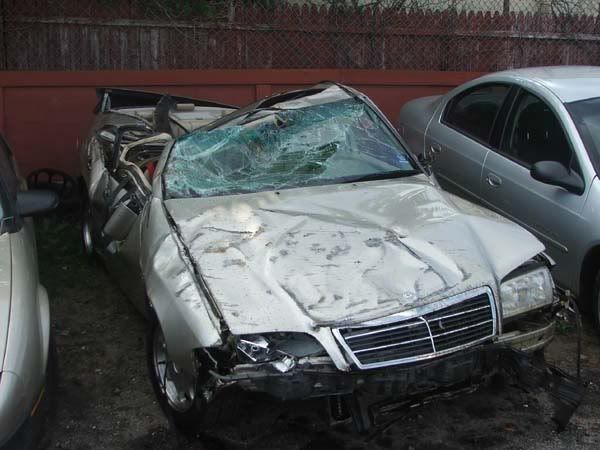
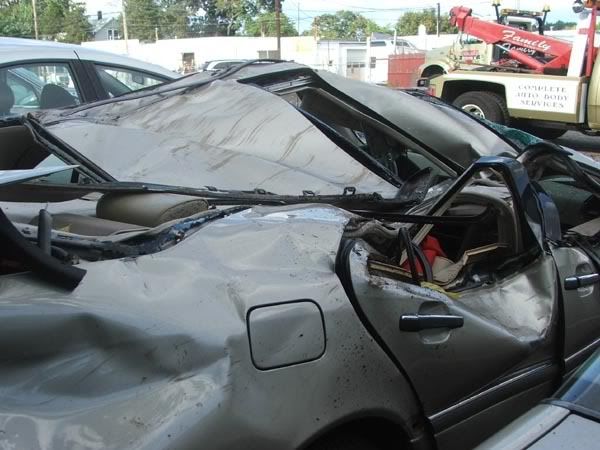
New Series "They walked away" Part 1
I have always wanted to create a group of images so powerful that their message would be indisputably clear, compelling and powerful. While I am still working on this as an artist, in fact, it is my life's work, I may be able to achieve one variation of it sooner as a Mercedes salesperson.
If just one thing I say, or demonstrate, convinces one family to choose a Mercedes over another car, and then someday their Mercedes gives its' life to save theirs, well, that's a pretty noble occupation, I think.
Every image in this series will be of a Mercedes that did just that, allowing the driver and passengers to walk away from a what might have been a potentially fatal crash.
If just one thing I say, or demonstrate, convinces one family to choose a Mercedes over another car, and then someday their Mercedes gives its' life to save theirs, well, that's a pretty noble occupation, I think.
Every image in this series will be of a Mercedes that did just that, allowing the driver and passengers to walk away from a what might have been a potentially fatal crash.
The driver of this E320 walked away from this crash.
Thank you, Mercedes engineers.
Wednesday, March 3, 2010
How not to park
Must have really been in a hurry to get a massage....or whatever they're offering at this establishment.
Subscribe to:
Posts (Atom)